(Datenstand: V1.1 vom August 2026)
THE ZIS SPIDER OF DISSOCIATION
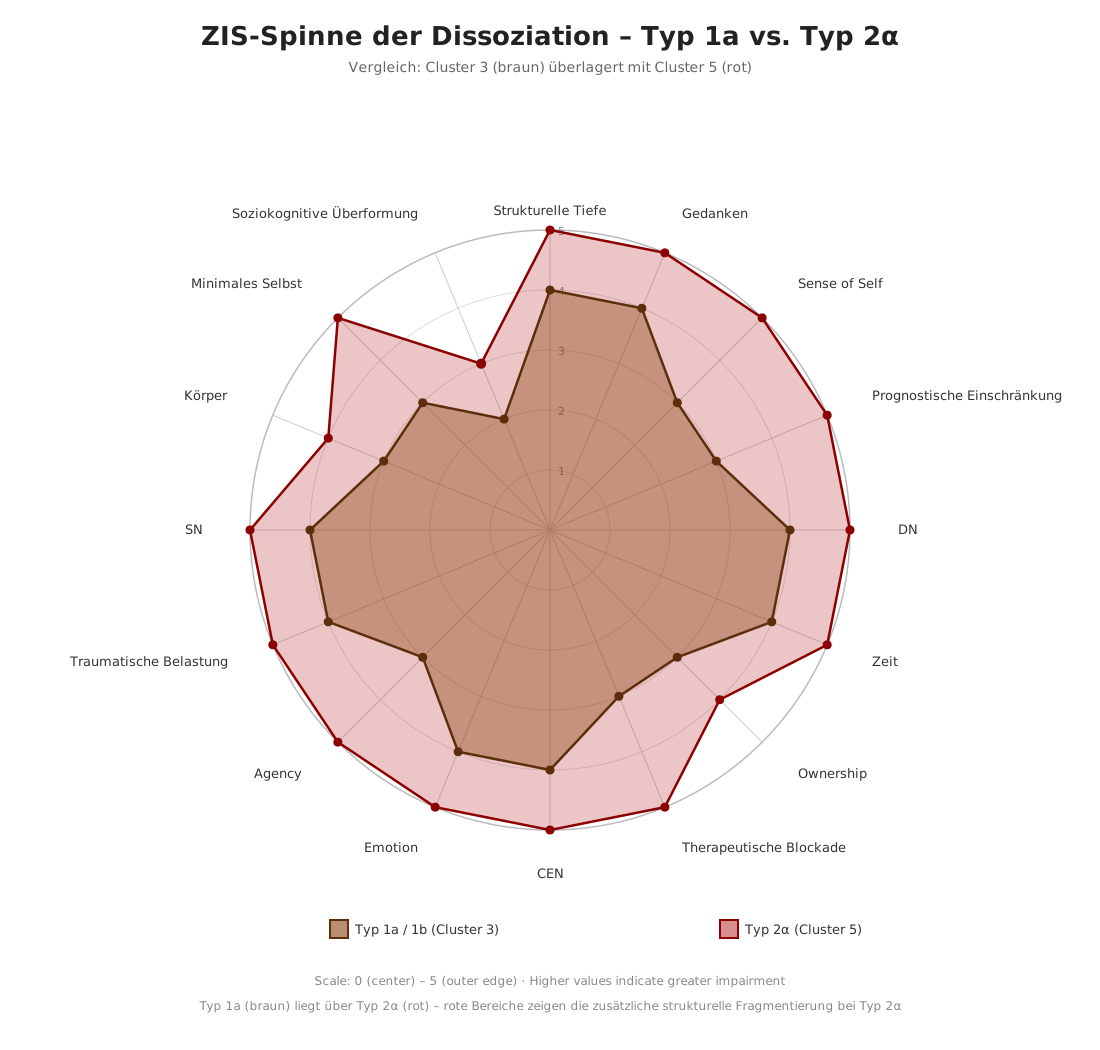
This list documents all ZIS spiders of the WA Corpus – from the original dissociation ZIS with 16 parameters through the extended 34-item applications to the questionnaires and parameter weighting. The ZIS family is the centerpiece of the diagnostic and therapeutic work in the case of Yenifer/Yenny: it makes visible what was invisible. It orders what seemed chaotic. It measures what seemed to elude every grasp.
The ZIS spider is not another model of dissociation. It is the map of models. It is the film that shows how the map changes when therapeutic work leaves its traces. It is the bridge between theory and practice – between the complementary models of Frewen & Lanius, Ataria, and Lebois and the concrete clinical decision at the patient's bedside.
Whoever understands the ZIS spider understands the structure of dissociation. Whoever applies it holds in their hand a tool that not only describes but also guides – and gives hope.
THE ZIS FAMILY AT A GLANCE – A GRAPHIC POSITIONING
The 25 documents of the ZIS family can be arranged into six thematic groups that map the path from foundational diagnostics through specific applications to methodological refinement:
- 1. Foundational instruments: The origin. The ZIS-16 is the fingerprint of dissociation. It is what everything began with – and what everything returns to.
- 2. Extended applications: The ZIS-34 expands the view to include resources and blockades. It asks not only what is missing, but also what is there – and what stands in the way.
- 3. Systemic applications: The ZIS leaves the individual and enters the world of relationships: the social environment, dyadic collusion, the transgenerational chain. It shows that dissociation is never merely an individual phenomenon.
- 4. Dynamic applications: The ZIS becomes mobile: it compares disorders across the spectrum, visualizes courses over time, and places itself within a map of maps.
- 5. Parameter weighting: The methodological deepening. Not all parameters are equally important. Weighting makes the clinical hierarchy visible – from structural depth to sociocognitive overlay.
- 6. Self-reflection of the companion: The ZIS turns toward the companion. It records what the companion brings – and what he must endure. It is the instrument of self-care and supervision.
1. Foundational Instruments (ZIS-16)
| Document | Short | Title | Description | WB Volume | Function | OSF/Tiefenlink |
|---|---|---|---|---|---|---|
| WAZ-080 | ZIS spider | The ZIS Spider of Dissociation – A radial assessment instrument for dissociative complexity | The original instrument, 16 parameters from four complementary models (4-D, Ataria, triple network, ZTD) – the fingerprint of dissociation | WB_01, WB_18 | Basic diagnostics | |
| WAA-821 | Questionnaire | Questionnaire for the ZIS Spider of Dissociation | Deficit-oriented survey with positive questions and inverted scale – 16 parameters, frequency-based | WB_18 | Questionnaire for ZIS-16 |
2. Extended Applications (ZIS-34 – Resources & Deficits)
| Document | Short | Title | Description | WB Volume | Function | OSF/Tiefenlink |
|---|---|---|---|---|---|---|
| WAA-840 | Resource ZIS | Resource ZIS – Complete parameter list (34 parameters) | Systematic assessment of personal resources in six dimensions – the positive perspective | WB_18 | Resource diagnostics | |
| WAA-841 | Questionnaire, Resource ZIS | Questionnaire for the Resource ZIS | Constructive assessment of personal resources – positively formulated, scale 0–5 | WB_18 | Resource questionnaire | |
| WAA-850 | Personality-blockade ZIS, deficit ZIS | Personality-Blockade ZIS – An instrument for assessing psychological blockades | Systematic assessment of psychological blockades in six dimensions – the deficit perspective | WB_18 | Blockade diagnostics | |
| WAA-851 | Questionnaire, deficit ZIS | Questionnaire for the Personality-Blockade ZIS | Constructive assessment of psychological blockades – negatively formulated, scale 0–5 | WB_18 | Blockade questionnaire |
3. Systemic Applications (ZIS-34)
| Document | Short | Title | Description | WB Volume | Function | OSF/Tiefenlink |
|---|---|---|---|---|---|---|
| WAA-860 | System ZIS, resource ZIS, deficit ZIS | System ZIS – Application of the ZIS spider to the social environment | Transfers the principle to the social environment – makes systemic stabilizers visible | WB_18 | Systemic diagnostics | |
| WAA-861 | Questionnaire, deficit ZIS | Deficit Questionnaire System ZIS | Deficit-oriented survey of systemic deficits – negatively formulated | WB_18 | System questionnaire (deficit) | |
| WAA-862 | Questionnaire, resource ZIS | Resource Questionnaire System ZIS | Resource-oriented survey of systemic resources – positively formulated | WB_18 | System questionnaire (resource) | |
| WAA-865 | Couple ZIS, resource ZIS, deficit ZIS | Couple ZIS – Application of the ZIS spider to dyadic dynamics | Transfers the principle to dyadic relationship dynamics – makes collusions visible | WB_18 | Couple diagnostics | |
| WAA-866 | Questionnaire, resource ZIS | Resource Questionnaire Couple ZIS | Dyad consideration – constructive assessment of dyadic resources | WB_18 | Couple questionnaire (resource) | |
| WAA-867 | Questionnaire, deficit ZIS | Deficit Questionnaire Couple ZIS | Dyad consideration – deficit-oriented assessment of dyadic challenges | WB_18 | Couple questionnaire (deficit) | |
| WAA-870 | Transgenerational ZIS, deficit ZIS | Transgenerational ZIS – Application of the ZIS to transgenerational transmission | Transfers the principle to the generational chain – makes continuity, radicalization, and rupture visible | WB_18 | Transgenerational diagnostics | |
| WAA-871 | Questionnaire, deficit ZIS | Questionnaire for the Transgenerational ZIS | Deficit-oriented survey with positive questions and inverted scale | WB_18 | Transgenerational questionnaire |
4. Dynamic Applications
| Document | Short | Title | Description | WB Volume | Function | OSF/Tiefenlink |
|---|---|---|---|---|---|---|
| WAA-820 | ZIS spider, application | Application of the ZIS Spider to the entire spectrum of dissociative phenomena | Five clusters – from phenomena without structural alteration to the inverted hierarchies of Type 2 | WB_18 | Spectrum analysis | |
| WAA-825 | ZIS spider, visualization, differential diagnostics, course ZIS | Visualization of differential diagnostics and treatment progress with the ZIS spider | DD-ZIS (overlay of disorder profiles) and longitudinal ZIS (course visualization) | WB_18 | Differential diagnostics & course | |
| WAA-830 | ZIS spider, map | Map of the ZIS family – Systematic overview of all ZIS spiders | Systematic overview of the entire ZIS family – the map of maps | WB_18 | Meta-documentation |
5. Parameter Weighting (ZIS-16 & ZIS-34)
| Document | Short | Title | Description | WB Volume | Function | OSF/Tiefenlink |
|---|---|---|---|---|---|---|
| WAA-880 | ZIS spider, weighting | Parameter weighting in the ZIS spider of dissociation | Methodological extension, linear and cluster-based weighting – scale 0–10 | WB_18 | Methodological foundation | |
| WAA-881 | ZIS spider, weighting | Discussion of the parameter weighting of the ZIS-16 | Detailed justification of the weighting for each of the 16 parameters | WB_18 | Weighting discussion ZIS-34 | |
| WAA-885 | ZIS spider, weighting | Base weights for the 34 parameters of the ZIS family | Base weights for all 34 parameters – independent of questionnaire context | WB_18 | Base weighting ZIS-34 | |
| WAA-886 | ZIS spider, weighting | Contextual adaptation of the weights | Questionnaire-specific weighting – orientation and perspective | WB_18 | Context weighting ZIS-34 | |
| WAA-887 | ZIS spider, weighting | Item-level correction and synthesis | Framing effects, DIF, factor loadings – merging of the three levels | WB_18 | Item weighting ZIS-34 |
6. Self-Reflection of the Companion
| Document | Short | Title | Description | WB Volume | Function | OSF/Tiefenlink |
|---|---|---|---|---|---|---|
| WAB-22 | Self-reflection ZIS, resource ZIS, deficit ZIS | Self-Reflection ZIS – An instrument for the companion, s self-reflection | Transfers the principle to the companion himself – records resources and burdens | WB_08 | Supervision & self-care | |
| WAB-23 | Questionnaire, resource ZIS | Questionnaire Self-Reflection ZIS – Resources of the companion | Resource-oriented survey – positively formulated | WB_08 | SR questionnaire (resource) | |
| WAB-24 | Questionnaire, deficit ZIS | Burden Questionnaire Self-Reflection ZIS | Deficit-oriented survey – negatively formulated | WB_08 | SR questionnaire (burden) |